A couple of weeks ago, my daughter asked me a question that I rarely thought about deeply, “Dad, does coming from a well rooted family background mean you are guaranteed to be successful in the future?”
I don’t know why my daughter asked me that question but I said “Of course, it gives you a lot of plus points. Think of it like you already have sufficient gasoline to start the engine in comparison to everyone else whose engine is empty. You have financial stability, good schooling, and a family network that opens many new doors for you but ordinary people have to knock many doors for many years for the same thing.”
My daughter further asked, “So, if you don’t come from that kind of well rooted family background, is it almost impossible to have exponential success?”
I said, “Not at all, but the path becomes more challenging and more labor intensive. A well rooted family background provides a safety net, especially financial safety. If a wealthy kid fails at any attempt for a particular goal, their parents or grandparents provide a cushion for them, they have sufficient dry powder to ignite again and again. If someone from a struggling or medium background fails, they might lose their whole life saving assets, so there is risk to take. But grit, financial literacy, and consistent smart work can bridge the gap over time.”
My daughter again asked, “Do you ever feel, when you were growing up, that our background held you back?”
I said “Of course, when I was young in high school and college, our family background determined my limits, but it didn’t define my future. Of course, it was hard and challenging but your grandparents taught me how to work hard, but they didn’t teach me how to grow or invest or start entrepreneurship which gives autonomy and freedom in life. By the way, they didn’t know about it so I am learning how to be free and autonomous in life at tortoise speed now. I will tell you this, your task now isn’t to resent where you started, but to use the foundation your grandparents and I built over the years whatever we could for you to go even further in the new territory. My belief is every new generation is equipped with new mindset and tools that the previous generation didn’t have access to, so definitely you should explore more territories that we were unaware of or could not explore.”
My daughter said, “I get it. Having a well rooted family background is like having a good map, but I still have to do the driving part carefully.”
I said, “Exactly, a map can be wasted if you lack discipline, consistency, and patience which are like your blind spots in your driving. Remember, starting from zero can become your greatest strength if you use these blind spots as your fuel.”
“Starting from zero can become your greatest strength in life if you use discipline, consistency, and patience as your fuel.”
This conversation with my daughter gave me enough fuel to pen down this writing.
In my own experience, success, sometimes, is not just of our own efforts, but a result of many other foundational factors.
It becomes a product of our family, culture, and society in which we lived and grew up.
Finding true success requires making sure we are the real writer of our own inner goals. Discovering at the end of our life that we chased someone else’s goal is a disaster.
Alain de Botton, the author of ‘Status Anxiety’ explores how we judge success and failure in his beautiful book.
Botton’s TedTalk ‘A kinder, gentler philosophy of success’ is worth watching.
Another striking thing I found when I was reading “Outliers” by Malcolm Gladwell is that when Bill Gates dropped out of Harvard after his sophomore year to start his own software company, he’d been practising computer programming non-stop for seven consecutive years.
Think about this, that is way more than 10 thousand hours that he practiced mostly during high school years, which gives mastery as described by some experts.
The original concept of 10 thousand hours for mastery was developed by Dr. Anders Ericsson, a psychologist and author of ‘Peak’ who studied elite violinists and found that top performers practiced thousands of hours of work.
Ericsson emphasizes in his book ‘Peak’ that the key is not only mere repetition of work which isn’t enough if the quality and intent of the practice is poor and superficial.
The quality and intent of our work practice corresponds to our inner goal which we write, re-write, polish, and re-polish again and again throughout our journey.
Just to get the perspective of 10 thousand hours, in graduate school in the US, 10,000 hours spent on average in any field with intent generally corresponds with a PhD or MD work from a university.
“The quality and intent of our work practice corresponds to our inner goal which we write, re-write, polish, and re-polish again and again throughout our journey.”
Robert Greene, the author of ‘Mastery’ concludes similar findings as reported by other authors Botton, Gladwell, and Ericsson.
Greene states that true greatness and power of mastery in any chosen field comes through deep dedication, rigorous practice, and historical backbone.
Greene gives case studies of historical talents like Albert Einstein, Charles Darwin, and Leonardo da Vinci to find common rules for success.
Greene advises especially younger folks “discover your unique calling which is your deep childhood curiosity and spend years absorbing rules, building basic skills, and learning from mentors.”
That’s exactly how Bill Gates, Albert Einstein, Charles Darwin, and Leonardo da Vinci did in their early careers to achieve real success.
I am really inspired by Greene’s passionate TedTalk ‘The key to Transforming Yourself’ where Greene shares the key to transforming ourselves and also talks about his own personal transformation and his path to becoming a bestselling author.
Remember, successful people don’t do success work alone, they bring success as a network effect where family network remains a key.
How you grew up and where you come from matters in the long run to shape our future.
Veteran investor Warren Buffett always says that he won the ovarian lottery because he was born at the right time at the right place.
Buffett said that he is the product of a particular place and particular environment.
“Remember, successful people don’t do success work alone, they bring success as a network effect where family network remains a key.”
Buffett always says that hard work is a trap only if the work doesn’t have meaning and interest in your lives.
Once it has meaning and interest, it becomes like singing and dancing in a birthday party.
If you don’t love what you do then there is somebody somewhere who loves what he or she does and certainly outcompetes you enormously in the long run.
If we work hard with good judgement, which has meaning and interest, and if we assert ourselves and use our mind and thinking properly, we can shape the world to our expectations.
Malcolm Gladwell, the author of ‘Outliers’ says “success isn’t a random act. It arises out of a predictable and powerful set of circumstances and opportunities.”
Both Malcolm Gladwell and Robert Greene agree that we should always do the work that we enjoy.
Success in the long run is more of a practical intelligence rather than just analytical IQ.
Practical intelligence is knowledge that helps us read various circumstances correctly and get what we want in a particular situation when we progress through life.
It’s not just knowledge and expertise we gain in our formal education that helps all the time.
Practical intelligence is social savviness that separates us from analytical ability measured by IQ.
Social savviness is knowledge and this set of skills need to be learned constantly throughout our lifetime.
Bill Gates developed and utilized this practical intelligence when he was building Microsoft and Warren Buffett used it when he was building Berkshire Hathaway.
A lot of times, practical intelligence primarily comes from our family, culture, and people we hang around, where we grew up and worked.
If we stack up our technical expertise with emotional intelligence, our success moves at an exponential rate after a certain time.
The key is continuous learning and stacking practical intelligence with our expertise with patience.
We never know when that patience sprouts in unimaginable ways in our favor.
“Social savviness is knowledge and this set of skills need to be learned constantly throughout our lifetime.”
I would like to add one more example from Warren Buffett.
Buffett always credits the one hundred dollars Dale Carnegie public speaking course he took in his early career as the single most important investment degree of his life.
Dale Carnegie has an influential evergreen classic book ‘How to Win Friends and Influence People’ for all of us.
By Dale’s course, Buffett says he developed communication, leadership, and persuasion skills.
Buffett realized that having brilliant investment ideas is not enough for his career, he must be able to communicate clearly to get others to follow and trust his ideas then only they invest in his ideas.
This is the stacking of communication and persuasion skills in his investing expertise for exponential growth.
David Livermore, author of ‘Cultural Intelligence’ says that developing mindfulness, empathy, and awareness to properly read and interpret cross cultural situations without defaulting to personal assumptions is key to sustaining success in an evolving mixed society.
One of the poor practical intelligences in today’s world is phubbing due to easy access to social media on our smart phone.
Phubbing is a portmanteau of phone and snubbing.
The act of ignoring someone who is with us and giving attention to our mobile phone instead.
Sherry Turkle, MIT professor and author of ‘Reclaiming Conversation’ says that phone distraction is a massive societal regression.
Professor Turkle explains that by checking our phones during a live interaction, we gain instant digital stimulation but lose the attribution of meaning and empathy for the person sitting right next to us.
This phubbing mechanism has weakened our capacity for solitude and deep conversation which are key requirements for exponential success.
Solitude and deep conversation are keys for deep work.
Simon Sinek, the author of ‘Start with Why’ says that when we place a phone on a table or hold it during a physical conversation, we send a subconscious message that the other person we are talking to is not our top priority.
According to Simon Sinek, this creates immediate doubt and fractures the quality of attention and destroys human connection.
Remember, deep work is the requirement for mastery like practical intelligence which is important for our expertise defense against failure.
Skills rich in practical intelligence are good judgement, patience, communication, thinking, discipline, and good temperament.
“Remember, deep work is the requirement for mastery like practical intelligence which is important for our expertise defense against failure.”
Social interaction is an essential ingredient of human success in today’s entrepreneurial world.
Social interaction with some deep technical expertise is like a meal with a spicy flavor in the current AI world.
The true way to success lies in the judicious overlapping of social interaction and deep expertise.
Just a thought provoking question for you.
If you are given a choice between being a community programmer for $80,000 a year and working as a security door man everyday for the rest of your life for $100,000 a year, which would you choose?
I’m guessing the community programmer, because there is mental work, autonomy, and satisfaction.
Not only that, there is no restriction on how long you are staying in the job as per your desire.
There is a beauty in having no restriction in our lives when we do something mental work, and that’s worth more to most of us than money.
This is called autonomy.
Mental work, autonomy, and satisfaction leads to exponential success once they interconnect for happiness.
“Mental work, autonomy, and satisfaction leads to exponential success once they interconnect for happiness.”
Daniel Pink, the author of ‘Drive’ says that true motivation for creative work relies on internal drives rather than traditional external rewards.
We have an inherent desire to direct our own lives, control our works, choose our techniques, and manage our own time.
Daniel Pink’s TedTalk ‘The puzzle of motivation’ is worth watching where he explores why traditional rewards aren’t always as effective as we think.
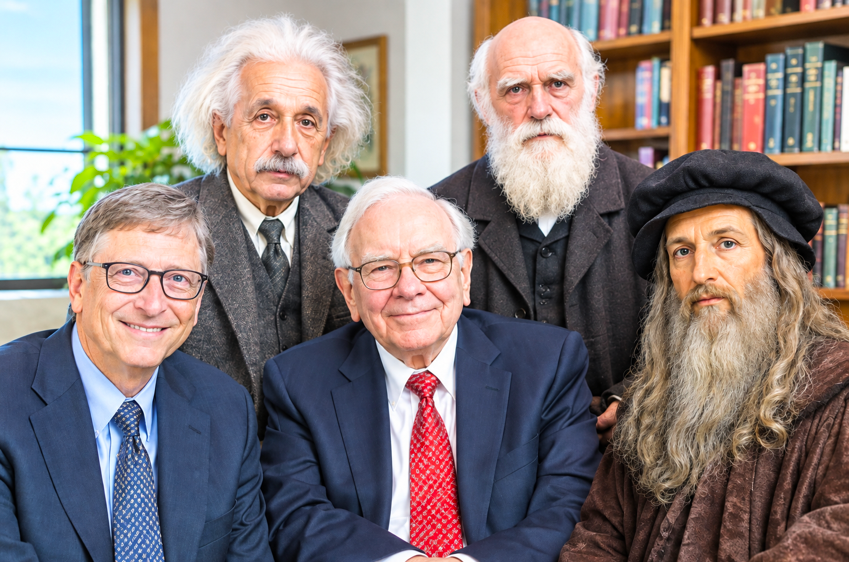
Remember, Bill Gates, Warren Buffett, Albert Einstein, Charles Darwin, and Leonardo da Vinci, all are operated by internal drives all the time.
Finally, exponential success is a progress that happens slowly at first and then accelerates rapidly into massive, non-linear fashion.
Unlike normal predictable linear success, where effort produces a steady and predictable outcome with some type of cap, exponential success resembles a sudden uptrend curve, where the previous results multiply based on gains of expertise and its stacking with emotional intelligence.
Pretty much, exponential success can be uncapped due to compounding power.
Conclusion
Starting from zero can become your greatest strength in life if you use discipline, consistency, and patience as your fuel.
The quality and intent of our work practice corresponds to our inner goal which we write, re-write, polish, and re-polish again and again throughout our journey.
Remember, successful people don’t do success work alone, they bring success as a network effect where family network remains a key.
Social savviness is knowledge and this set of skills need to be learned constantly throughout our lifetime.
Deep work is the requirement for mastery like practical intelligence which is important for our expertise defense against failure.
Mental work, autonomy, and satisfaction leads to exponential success once they interconnect for happiness.
Yam Timsina, PhD, writes primarily on health basics, scientific progress, social upliftment, and value creation.
Disclaimer: “Please note that some links in this post are affiliate links, which means I may receive a small commission if you make a purchase through them, at no extra cost to you.”