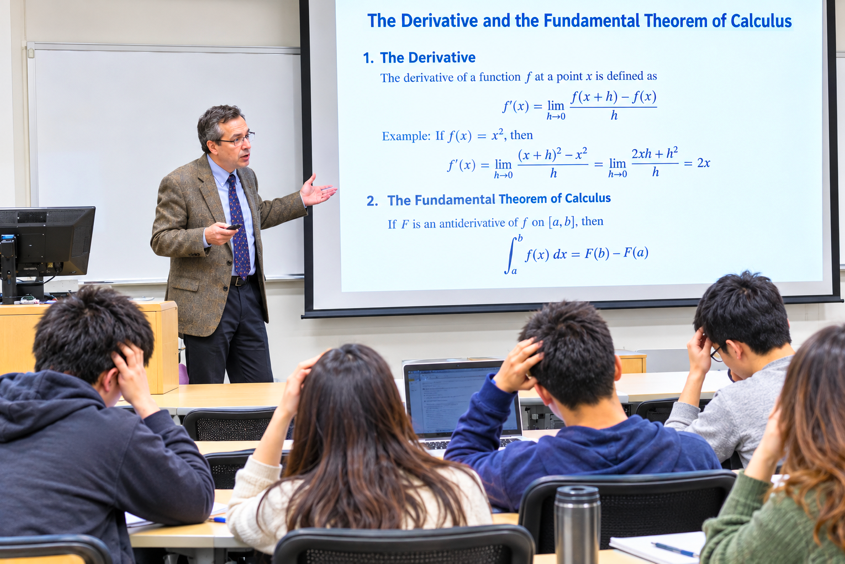
I was inside the room and one of my former student asked his math teacher, “ Why do I need to know algebra and calculus?’’
He further questioned, “Where do I use it in my life?’’
His teacher gave him all abstract answers, not a single concrete and real life experience answer.
One of the answers was “Algebra teaches procedures to manipulate symbols for better understanding of the world.”
Another answer was “Calculus teaches the relationship between variable quantities.”
I was shocked. My former student was suffering in algebra in high school, so he didn’t grasp any information about what his math teacher said to him. Later, he took the same question to two other professionals outside his classroom.
The first professional was his physician, MD in internal medicine in his city hospital, and asked him the same question.
His physician replied to him, “I never used either algebra or calculus in my life, except to use it to get admission to medical school.”
The second person whom my student asked the same question was his father’s 81 years old math teacher, and again he asked the same question.
His father’s old math teacher said, “I never used algebra in my life except to teach algebra at high school for living.”
“Old math teacher: I never used algebra in my life except to teach algebra at high school for living.”
Whether you agree or not, these two professionals are telling the truth. In most circumstances, the so-called subject matter experts, especially in science and math like my former student’s math teacher, provide a curse of knowledge.
Many journal articles, science stories, and reviews are written for other people like authors, not for the general audience.
The main concern is why don’t we connect the general audience from scientific writing?
We have to make our science and math with a message that makes most of the ordinary people care about it.
Don’t let the curse of knowledge prevent you from using it well.
Charlie Munger, a veteran investor and author of ‘Poor Charlie’s Almanack’ says “take off jargons from your language, show how knowledge, discoveries, and ideas are associated with things that ordinary people care about. Knowledge is useless until we know it has value for others.”
Have you ever tried to answer these questions? One of my mentors asked me recently.
Who are you as a person and where do you come from?
What is your main goal in life?
These are hard questions to answer if we go in depth but easy to answer superficially.
We can connect the first two questions with the intent of the following question.
Is knowledge the medium or the end goal for us?
So, what do we think the algebra is? The medium or the end goal.
My former student is a 12th grader. I don’t know when he considered himself a proponent of real life education.
He told me, “I’ve met people many times less knowledgeable than me and many times more knowledgeable than me in algebra, and some people 100 times more knowledgeable than those whom I consider knowledgeable. All of these knowledgeable people are truly dirt poor in knowledge of algebra in front of the professional runner woman I met in the running club.”
He asked the same algebra question to a woman, a professional runner.
She said, “Yes, I’ve used algebra in my whole life to achieve success in my field. Even though I never did any abstract algebra calculation in my life after high school, it helped me to think properly and logically in order, it gave me a tough brain training which I utilize every single day in my running life.”
Only knowledge doesn’t help, but its connection to real life boosts all of us.
Many people in the core field of math and science like my former student’s math teacher forget that other people don’t know what they know.
“Only knowledge doesn’t help, but its connection to real life boosts all of us.”
How we convey the work of scientists and mathematicians for an ordinary audience is challenging. To understand this part, we need to communicate a gap in our knowledge.
The tendency to become overconfident about how much we know about the raw data and algebra needs to be addressed.
Math and science language are often abstract, but life is completely different, it is beyond abstract.
Abstraction makes it difficult to understand an idea and its connection to life.
Chip Heath and Dan Heath, authors of ‘Made to Stick’ say that our brain contains so many tools that create connections. If connection is so powerful, why do we slip so easily into abstraction?
Experts speak different languages, they think abstractly on math and science but ordinary people think on real ground.
If we read the autobiography of Steve Jobs, by the way a must-read book by Walter Isaacson, he always emphasized simplifying complex technology for the ordinary user. Our experts on R&D want to make complex and sophisticated products, but our customers want easy and reliable products and technologies like the iPhone which anybody can use.
The goal of ordinary people should be met.
Exactly the same applies in conveying science language, the huge communication gap exists and needs to be removed.
Research indicates that only about 20 percent of papers cited have actually been read. Data shows that an average paper in a peer-reviewed journal is read completely by around 10 people.
This clearly indicates that the impact of most peer-reviewed publications even within the scientific community is very very small.
Real communication is a way of bringing math and science into our community.
Our brain works on the concept of visualization, therefore, it helps to transform math and science to ordinary level.
How did the runner woman visualize high school algebra in her professional life?
She connected the lesson of algebra to her emotional maturity, and she conveyed it nicely to my former student.
She can inspire others why algebra is important in high school, her message carries emotion and strength.
Algebra not only helps to solve complex math problems or secure good grades in tests but also makes you think toughly in life.
“Our brain works on the concept of visualization, therefore, it helps to transform math and science to ordinary level.”
Carl Sagan, an American astronomer and planetary scientist says that emotion and personal connection are more powerful to convey the message of abstract materials like math and science.
Most of our peer-reviewed journals begin with an abstract.
The beginning is already very dry for the general readers.
Robin Warren, a staff pathologist at a hospital, and Barry Marshall, an internist in training, discovered H. Pylori bacteria which causes ulcer in our body.
Initially nobody believed, especially the experts in the area.
At one point in Marshall’s life, he poisoned himself to prove his science due to desperation. Ordinary people paid attention, read their stories, and in 2005, they got the Nobel prize in medicine for their work.
Science and math speak volumes, emotions, and diversity because it brings ordinary audiences to a cause, a cause to improve life, and cause to cure life.
When my daughter asks me, “Tell me a story,” at bedtime, she is looking for entertainment, not any instruction or knowledge.
I tell a story about a periodic table, but not as abstract science, elements, symbols and names, columns, and rows.
In my story, she makes a picture of a periodic table in her mind.
She shouldn’t remain only a passive listener.
The story provides the context of knowledge to my daughter which is missing in abstract science.
The runner woman, her story about algebra, its understanding and putting it into a real life framework is inspiring to others.
When my former student asked an algebra question to his physician, he said, “When I was becoming a doctor in medical school, I needed every answer of my body organs as well as expertise. But now I have to convey my expertise to the masses.”
He added, “I must dissociate my expertise from the curse of knowledge. I know many things that the general audience don’t know but I should get around the general audience to share the information. I need to communicate as if I am in the audience.”
Viktor Frankl, a psychiatrist, philosopher, and author of bestselling memoir ‘Man’s Search for Meaning’ used to say how we relate our work, our findings to the day-to-day work and day-to-day people is how we set our value in life.
Some of the existing curse of expertise needs to be cured.
We become a medical doctor with MD without taking a single communication class.
We become a CEO of a business with an MBA without taking a single class in communication.
We become a professor of mathematics with a PhD without taking a single class on how to teach and how to communicate.
Due to these leaks in our education system, knowledge becomes a curse for the general audience and gives no value to them.
“We become a professor of mathematics with a PhD without taking a single class on how to teach and how to communicate.”
Imagine attending an hour-long powerpoint presentation from an expert and nothing sticks in your memory after the presentation, you are just exposed with a curse of knowledge.
Remember, people care more about individual impact than they do care about abstract math and science.
Even though many current students are struggling to learn algebra and calculus in school and many of their math journeys end there.
At present most engineering designs are replaced by computer software so the real application of our algebra and calculus need to be redefined.
Conclusion
An old math teacher said “I never used algebra in my life except to teach algebra at high school for living. Therefore, only knowledge doesn’t help, but its connection to real life boosts all of us. Our brain works on the concept of visualization, therefore, it helps to transform math and science to ordinary people. We become a professor of mathematics with a PhD without taking a single class on how to teach and how to communicate. Let’s make the language of science and math an ordinary language. Remember, all time genius, Albert Einstein, “nothing beats simplicity.”
Yam Timsina, PhD, writes primarily on health basics, scientific progress, social upliftment, and value creation.
Disclaimer: “Please note that some links in this post are affiliate links, which means I may receive a small commission if you make a purchase through them, at no extra cost to you.”