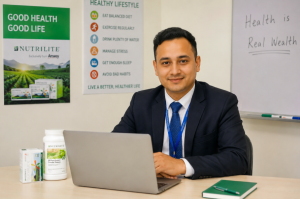
How healthy are you?
Are you really living with your full potential, or you are just pretending to be healthy? By giving answer to this question, you clearly express your strength and limitation in life. Remember, the struggle behind the discovery of one normal drug for a disease still costs around one billion dollar and up to ten years of precious time.
Another clear question to you is, how educated are you?
I am not talking about Ivy League’s diploma and certificate, I’m talking about the general understanding of life, lifespan, health span, and nutrition. How well do you keep yourself aware about your profession, your health and new innovation in society? Education is not only knowing the mundane stuff; it is understanding of the world in various aspects and adding a new layer of knowledge on top of your understanding to simplify your life.
If you force your kids to memorize the capital cities of African countries, then it doesn’t take long to be obsolete in today’s Google and AI’s society. Education is to create value to other people to improve their lives; not to memorize capital cities unless to participate in quiz competition. Albert Einstein, the genius of all time, famously said, “The value of a college education is not the learning of many facts but the training of the mind to think”.
“By opening mouth, we know, nobody learns.”
Clearly, education and healthcare business are the fastest growing businesses at the moment and will remain the same in the future. If we are not careful how we are living our lives then majority of our finances will be absorbed by these two sectors in coming days. Education and healthcare require more urgency and priority than any other thing in life. Economists and sociologists like Theodore Schultz and Gary Becker, posits that both areas of education and healthcare heavily involve a lot of resources including instruments, technology, teaching, training and instructing people around us.
How well do you persuade other people is the key skill in education and healthcare. As being a scientist for more than a decade now, I can tell that persuading skillset is far more important than technical knowledge and skills in innovation industries. Teachers and doctors both should convince others, both should care and support others.
Another skill, how to open both ears and close a single mouth, is directly and indirectly related to persuading power.
By opening mouth, we know, nobody learns.
Listen more from your students, patients, parents, and family members. I have had experiences of doctor interrupting me as a patient in the first round of talk where I was detailing the cause of pain and suffering.
“The skill of asking better questions is way more productive and useful than finding the correct answers in today’s technology driven world.”
Few years ago, I was teaching chemistry to sophomores. I was telling students to write about the topic I assigned to them. Almost ninety nine percent obeyed my topic, but few students did not. They choose their topic but not mine. During grading what I realized is that students who wrote their own topic excelled far well than those who wrote my assigned topic. This exercise helped me to improve my teaching understanding, the key is making the student centerpiece. Teaching is a knowledge transfer skillset, so the power of choice enhances the optimism in students, which is required in today’s education especially in Google and AI age. Angela Duckworth, psychologist and author of ‘Grit‘ shows that teacher optimism boosts student achievement, linking directly to fostering student agency and hope. Angela’s TedTalk ‘The Power of Passion and Perseverance‘ is worth watching regarding teaching and learning.
Another effective tool to get student’s inherent curiosity is teach to ask questions. Mostly asking uncommon and open ended questions forces them to think. The skill of asking better questions is way more productive and useful than finding the correct answers in today’s technology driven world. This is in direct conflict with current teaching and learning process because most of us learned from our school, college, and parent how to answer but not how to question. Questing is still considered unethical in many circumstances, this is equally important for doctors. We must encourage and teach students and patients how to ask questions especially open ended questions which avoids yes or no answers.
“Indirect questioning amplifies person’s positive intrinsic motivation for study.”
My cousin was not studying even before the day of chemistry test. Rather than to ask direct command question like “go and study for chemistry test tomorrow”, I asked her some indirect questions.
“How much will you score in chemistry test tomorrow?”
She told me, “5 out of 10.”
I again asked, “Are you sure? I’m just curious, why you are not picking 3?”
She said, “What? I deserve better than 3.”
I noticed that this indirect questioning amplified my cousin’s personal positive intrinsic motivation for study. Edward Deci and Richard Ryan, renowned psychologists, says that indirect, autonomy-supportive techniques like open ended questioning rather than controlling directives enhance intrinsic motivation in students.
Conclusion
Imagine similar consequences if doctors apply this strategy to their chronic patients.
Now a days, a sophomore student with internet excess can have more information on the mechanism of Diels-Alder reaction with 3D simulation model than his or her 1980’s PhD professor.
Doctors are really busy people; they have to see assigned number of patients in a day. Don’t instruct the patient what to do and not to do but listen their details, habits, behaviors, and patterns to act accordingly. Nowadays patients arrive in clinic after doing intense research and reading about their disease and problem. Teaching and treating patient are same old concepts but we have to deal in a new way and a new approach. We have to reinforce the idea that there are no new teachings or treatments, only new approaches to execute old and existing ideas. Let’s teach every kid like we are teaching our own kid and treat every patient like we are treating our own dad. How does it feel? I’m sure it feels great for a long period of time.
Yam Timsina, PhD, writes primarily on health basics, scientific progress, social upliftment, and value creation.
Disclaimer: “Please note that some links in this post are affiliate links, which means I may receive a small commission if you make a purchase through them, at no extra cost to you.”